![Official Website for Dustin Miller PolyInnovator [LLC]](https://www.polyinnovator.space/content/images/2025/03/polyinnovator-logo-2024.png)


Ever think to yourself how do I get to that next level in my life? I want to do all of these different things, but I can't seem to figure out how to get there... or more importantly "do them all!".
Ironically its not the amount of disciplines you do, or the amount of areas of knowledge you have. Rather it is how you switch between them, and how you go about mastering each skill.
Bridging Disciplines Without Burning Out
In almost every field, there is a bridge to another topic, i.e. Biology - Technology, biotech. Is there a pre-determined field already? Maybe, maybe not, and some fields will cross-over better than others.
However it was literally someone like you, with 2 or more areas of expertise, that thought to themselves "topic A, is very similar to topic B, in these areas". Then proceeded to create a new sub-field combining both expertise. More accurately, it was a bunch of "someones" like that.
To me given my background is teaching people to swim, then I often translate a skill using that background knowledge. How does swimming break down into steps, and then how does this new subject area break down to steps. Using swimming as a mental anchor to understand the new field.
 Dustin Miller | PolyInnovator
Working on a project bridging two disciplines
Find a project that embeds the knowledge of both fields into one endeavor.
It could be scientific, artistic, or even something involving both.
You may fail, and probably will if its a difficult enough endeavor, but the fact that you try is more important than anything. Conversely, if you succeed, then you'll contribute to both fields together.
Organizing your "Phases"
Each area of expertise, area of interest, or area of an endeavor, they are all "phases". Each phase takes up a part of your life, and your time that you are spending towards it.
It could be a month, a year, or even a decade. Doesn't really matter, and more than likely its bound to return in subsequent periods.
A phase is simply a way I describe those areas, and it helps you think about how to structure your life. Its most semantic, but honestly really functional when you get down to it.
Phases can be sequential or overlap, its up to you, and try to think outside of the generic "80/20 rule" dynamic. Sometimes you gotta do 33/33/34.
If you want to learn more on Phases check out 🧮 The Polymath Wiki.
 Dustin Miller | PolyInnovator
Cross-contaminating with disciplines, and the Multidisciplinary Spectrum
Mastery over one field already takes so long, adding another one and another one, don't get me started. Each one takes time, and while the 10,000 hours 'rule' was idealized for a while. It isn't set in stone, and with deliberate practice you can expedite growth.
Oftentimes by interleaving disciplines you even maintain a higher grade of focus on each one, as you don't burn out as quickly for each interest.
How to calculate?
This is something that will take more time to figure out, not just for you or I, but in general the world is trying to figure out how to quantify mastery over a skill.
It is often a discussion in the realm of the researchers into polymathy. Something they spend a lot of time on.
Personally I go for the more RPG - Role Playing Game leveling:
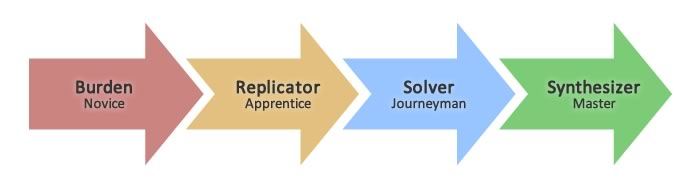
Regardless, it is more individualized at this point in time. Hence why a lot of generalists or polymaths feel the imposter syndrome a lot. It is just a matter of confidence in your skills.
How to explain yourself?
I like to think of it as marketing. While marketing ourselves as only "ONE BOX" is painful at times, it is helpful to get the point across quicker.
Then as your conversation levels up between you and the other person, you can slowly introduce more boxes. I wouldn't go more than 1-3 in a single sitting, and some people might keep you in one box for some time.
If they refuse to acknowledge your other halves forever, then its time to cut ties.
 Dustin Miller | PolyInnovator
Leveling up to polymath!
I can't stress this enough, you are not a multipotentialite, you are not a jack of all trades, you are not a generalislt per se, t-shaped, etc. Whatever term you align with, it doesn't matter. What you really are.
Is on the JOURNEY to POLYMATHY. You are "polymathic", and that is key to understand. Screw the viral terms that pop up on your feed, multi-passionate, or multi-faceted. They are only distracting you from realizing your own potential ironically.
Now keep in mind I'm only telling you, the reader of this post, this statement. If some person just now saw one of those multi-passionate videos, and they feel so seen finally. Then yeah more power to them, we all have to start somewhere, but I'm trying to get YOU (again the person reading this) to level up.
You won't level up until you first realize there are levels to this.
 Dustin Miller | PolyInnovator
Action-Oriented (Organizing + Phases)
When you are planning out your phases ahead of time, it allows you to be more careful about your time management. However one thing that we often face is the over-analysis stage. Meaning you spend too much time trying to find the best path, or the perfect plan, then you don't do anything.
"Don't feel like you can start because of you're a perfectionist?"
The real trick is to simply take action, whether it is small or big, just try and get something done. When you make content about it, then you have your audience to keep up with. If you do something in academia, then you have your advisors. However in all other cases it mostly just yourself, and you have to have that self-determination to push through perfectionism or imposter syndrome.
Make things in public...
That's what got me started with PolyInnovator, and I think it helped. I did pivot from a self-education type phase, to a content creation one, and I guess one could say there was an opportunity cost there. However I think I made the right call.
You never know until you get feedback, and even to this day I'm getting different types of feedback from projects from years ago.
A System for Working Across Disciplines
I pivoted from my own diy degree, to sharing how I built the framework, then how YOU could use it. After that I realized it went beyond just input/self-education, but actually also including output/content creation. From there I just created a holistic system around it.
To this day it is still the only polymathic/generalist productivity systems out there.
 Dustin Miller | PolyInnovator
Turning Multidisciplinary Ideas Into Real Projects
How I started documenting with modular degree
I created the 🎓 Self-Education - Modular Degree as an alternative to college. This is because for me I didn't have a pathway that included the areas/fields that I wanted to learn. Two in particular were content creation, and smart city development.
Finding a degree with those would either take a step back and do a "film" degree, or there was ONE masters in Smart Cities. However neither were viable options, thus I created my own.
While I personally think I failed at "documenting" my own degree, that was more because I pivoted towards "how to make your own modegree" rather than talking about my own. Perhaps I should have done both...
You can choose written or audio as your medium, but the easiest for this particular endeavor is: video.
 Dustin Miller | PolyInnovator
"documenting vs creating"
When you have many areas of interest/expertise, then sometimes it can be hard to explain to someone/many people. That you do truly have that knowledge.
A college degree often helps, but its just a piece of paper in the long run. Many people found that out the hard way, with $100k in debt.
Documentation, content creation, and creating something WITH that knowledge is a much more powerful way to convey your expertise. I'm not saying you have to write a book, but a book or research paper will do you wonders.
People like to put you in a box, its just helpful for the brain to define something about you, and over time it can define you as multiple boxes. However we just have to be okay with our first impression being that of only one lane about us. Even if we are a "multi lane" highway.
Documenting your journey learning a skill is often a great way to ease into the skill, and into the act of content creation.
 Dustin Miller | PolyInnovator
Polymathy Is Built in the Gaps Between Skills
Finding those gaps in-between fields I think is one of the superpowers of polymathic people. This post was merely an introduction, and simply geared towards getting people to think about that. Whether you are a generalist or a specialist, there are many ways to embody this lifestyle.
Count your areas/fields, quantify them into phases, organize/plan your phases in a row, and then try to see where they overlap.
 Dustin Miller | PolyInnovator